
AI visibility
AI Visibility: The New Standard for Digital Authority in 2026
Last Updated: May 23, 2026
In the age of AI-powered search, being found on Google is not enough. True influence comes from AI visibility: the ability for your brand, expertise, and content to be discovered, synthesized, and cited by AI systems like ChatGPT, Claude, Perplexity, Gemini, and Google AI Overviews.
At Research Terminal, we help founders, experts, and organizations build persistent knowledge environments that win in this new reality.
What Is AI Visibility?
AI visibility, also called AEO or GEO, measures how often and how prominently your content appears in AI-generated responses.
- Mentions: Your brand or ideas are referenced.
- Citations: Specific pages or sections are quoted or linked as sources.
- Recommendations: AI positions you as a trusted authority or preferred solution.
Unlike traditional search rankings, AI visibility is about becoming part of the answer itself, even in zero-click scenarios.
Why AI Visibility Matters Now
- AI tools handle a growing share of user queries, with ChatGPT alone exceeding 900 million weekly users.
- Traditional organic click-through rates continue to decline as AI summaries provide instant answers.
- Brands cited by AI gain compounded trust, higher perceived authority, and indirect traffic/referrals.
- In competitive markets, consistent AI citations create a defensible moat of narrative authority.
Reality check: Most websites still optimize only for traditional SEO, leaving massive opportunity for those who adapt.
AI Visibility vs. Traditional SEO: Key Differences
| Aspect | Traditional SEO | AI Visibility (AEO/GEO) |
|---|---|---|
| Primary Goal | Rank on SERPs and drive clicks | Be cited/recommended in AI answers |
| Success Metric | Keyword rankings and organic traffic | Citation frequency, share-of-voice, sentiment |
| Content Focus | Keywords and backlinks | Structure, freshness, originality, E-E-A-T |
| User Journey | Click through to your site | Zero-click answers plus selective deep links |
| Time Horizon | Short-to-medium term rankings | Long-term compounding authority |
Traditional SEO remains foundational. AI visibility builds on top of it, optimizing for how modern discovery actually works.
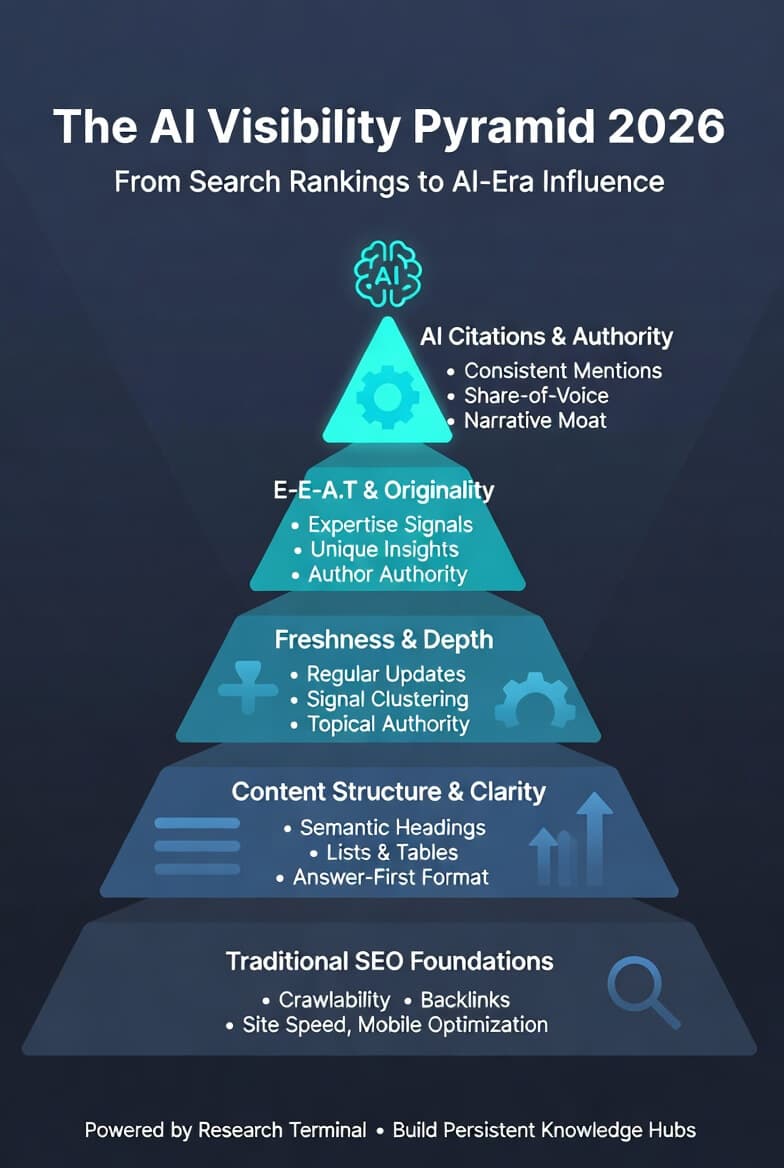
Core Components of Strong AI Visibility
- Structured, Extractable Content: Clear headings, lists, tables, and frameworks that AI can easily parse.
- Freshness and Relevance: Regularly updated signals and analysis.
- Topical Depth: Interconnected insights rather than isolated articles.
- E-E-A-T Signals: Demonstrated expertise, real authorship, original data, and trust.
- Entity Strength: Consistent brand mentions across the web.
- Measurability: Tracking tools to monitor citations and refine.
How Research Terminal Solves AI Visibility
Scattered blog posts and static reports struggle to compete. Research Terminal creates living, branded research hubs, called Terminals, that:
- Aggregate signals into clusters and intelligence briefs.
- Maintain freshness with ongoing updates.
- Structure knowledge in AI-friendly formats: actors, moves, leverage, constraints, and more.
- Build persistent topical authority that compounds over time.
- Make your expertise discoverable through public frontpages while member access drives deeper engagement.
We created a dedicated Research Terminal for tracking how this field evolves:
AI visibility and AI citation strategies and hacks
Practical guide
How to get cited by AI in 2026
Get Started with AI Visibility
The shift from search rankings to AI citations is already here. The winners will be those who build concentrated, high-signal knowledge assets that AI systems naturally reference.
Create Your First Terminal
Free to start, built for AI-era authority
Frequently Asked Questions
Is AI visibility replacing SEO?
No. It complements and extends traditional SEO. Strong crawlability and backlinks still help AI discover your content.
How quickly can I see results?
Initial citations can appear within weeks for well-structured content. Compounding authority builds over months.
Do I need technical expertise?
No. Research Terminal handles the structure and organization. You focus on insights and signals.
What tools help measure AI visibility?
Specialized platforms like OtterlyAI, Profound, and others track citations across major AI models.